# Initialize Otter
import otter
grader = otter.Notebook("hw01.ipynb")
Homework 1: Causality and Expressions
Please complete this notebook by filling in the cells provided. Before you begin, run the previous cell to load the provided tests.
Recommended Readings:
For all problems that you must write explanations and sentences for, you must provide your answer in the designated space. Moreover, throughout this homework and all future ones, please be sure to not re-assign variables throughout the notebook! For example, if you use max_temperature in your answer to one question, do not reassign it later on. Otherwise, you will fail tests that you thought you were passing previously!
Deadline:
This assignment is due Wednesday, 1/28 at 11:00am PT. Submissions after this time will be accepted for 24 hours and will incur a 20% penalty. Any submissions later than Thursday, 1/29 at 11:00am PT will not be accepted unless an extension has been granted. Turn it in by Tuesday, 1/27 at 11:00am PT for 5 extra credit points. For more information check our syllabus page.
Directly sharing answers is not okay, but discussing problems with the course staff or with other students is encouraged. Refer to the syllabus page to learn more about how to learn cooperatively.
You should start early so that you have time to get help if you’re stuck. Office hours are held Monday-Friday. The schedule appears on our website.
# Just run this cell!
# No need to worry about what this code means

from IPython.display import Javascript, display
display(Javascript(r"""
(() => {
  function pathLooksLikeTyping(e) {
    const path = e.composedPath ? e.composedPath() : [];
    for (const n of path) {
      if (!n) continue;
      if (n.tagName === 'INPUT' || n.tagName === 'TEXTAREA') return true;
      if (n.isContentEditable) return true;
      const role = n.getAttribute?.('role');
      if (role === 'textbox' || role === 'combobox' || role === 'searchbox') return true;
      const ariaMulti = n.getAttribute?.('aria-multiline');
      if (ariaMulti === 'true') return true;
      const cls = (n.className || "").toString().toLowerCase();
    }
    return false;
  }
  function handler(e) {
    if (e.key !== 'o' && e.key !== 'O') return;
    if (pathLooksLikeTyping(e)) {
      e.stopPropagation();
      if (e.stopImmediatePropagation) e.stopImmediatePropagation();
      if (e.nativeEvent?.stopImmediatePropagation) e.nativeEvent.stopImmediatePropagation();
      return;
    }
    e.preventDefault();
    e.stopPropagation();
    if (e.stopImmediatePropagation) e.stopImmediatePropagation();
    if (e.nativeEvent?.stopImmediatePropagation) e.nativeEvent.stopImmediatePropagation();
  }
  window.addEventListener('keydown', handler, true);
  window.addEventListener('keypress', handler, true);
  console.log("Installed: 'o' won't toggle output; 'o' should type inside any textbox-like UI (including JupyTutor).");
})();
"""))Question 1.1 An ad for ADT Security Systems says,
“When you go on vacation, burglars go to work [...] According to FBI statistics, over 25% of home burglaries occur between Memorial Day to Labor Day.”
Do the data in the ad support the claim that burglars are more likely to go to work during the time between Memorial Day to Labor Day? Answer the question by filling in the blanks below. For each blank, choose one of the listed options. (6 Points)
__(a)__. Since __(b)__, we can conclude that __(c)__.
Note: You can assume that “over 25%” means only slightly over. Had it been much over, say closer to 30%, then the marketers would have said so.
Note: Memorial Day is observed on the last Monday of May and Labor Day is observed on the first Monday of September.
Note: If you run into a NameError: name 'grader' is not defined error in the autograder cell below (and in any assignment), please re-run the first cell at the very top of this notebook!
Blank (a)
Yes
No
Not enough information
Blank (b)
over 25% of home burglaries happen between Memorial Day and Labor Day, which is a large percentage
there is no controlled experiment in this observational analysis
the exact percentage of burglaries between Memorial Day and Labor Day is unknown
there is more than one plausible explanation for the high percentage of burglaries between Memorial Day and Labor Day
Labor Day is around 14 weeks after Memorial Day, which is slightly more than 25% of a year
the number of burglaries between Memorial Day and Labor Day varies from year to year
Blank (c)
the number of burglaries is clearly elevated between Memorial Day and Labor Day
the rate of burglaries is clearly elevated between Memorial Day and Labor Day
the proportion of burglaries would be expected if burglars went to work at the same rate all year
the high rate of burgarlies in one year does not guarantee a high rate in future years
the evidence can neither support or deny this claim
the evidence is in favor of the claim
a = ...
b = ...
c = ...grader.check("q1")In lecture, we counted the number of times that the literary characters were named in each chapter of the classic book, Little Women. In computer science, the word “character” also refers to a letter, digit, space, or punctuation mark; any single element of a text. The following code generates a scatter plot in which each dot corresponds to a chapter of Little Women. The horizontal position of a dot measures the number of periods in the chapter. The vertical position measures the total number of characters.
# Just run this cell.

# This cell contains code that hasn't yet been covered in the course,
# but you should be able to interpret the scatter plot it generates.

from datascience import *
from urllib.request import urlopen
import numpy as np
%matplotlib inline

little_women_url = 'https://www.inferentialthinking.com/data/little_women.txt'
chapters = urlopen(little_women_url).read().decode().split('CHAPTER ')[1:]
text = Table().with_column('Chapters', chapters)
Table().with_columns(
    'Periods',    np.char.count(chapters, '.'),
    'Characters', text.apply(len, 0)
    ).scatter(0)
Question 2.1. Around how many periods are there in the chapter with the most characters? Assign either 1, 2, 3, 4, or 5 to the name characters_q1 below. (4 Points)
250
390
440
32,000
40,000
characters_q1 = ...grader.check("q2_1")Question 2.2. Which of the following chapters has the most characters per period? Assign either 1, 2, or 3 to the name characters_q2 below. (4 Points)
The chapter with about 60 periods
The chapter with about 350 periods
The chapter with about 440 periods
characters_q2 = ...grader.check("q2_2")To discover more interesting facts from this plot, check out Section 1.3.2 in the textbook.
Question 3.1. When you run the following cell, Python produces a cryptic error message.
4 = 2 + 2Choose the best explanation of what’s wrong with the code, and then assign 1, 2, 3, or 4 to names_q1 below to indicate your answer. (4 Points)
Python is smart and already knows
4 = 2 + 2.In Python, it’s a rule that the
=sign must have a variable name to its left, and4isn’t a variable name.It should be
2 + 2 = 4.I don’t get an error message. This is a trick question.
names_q1 = ...grader.check("q3_1")Question 3.2. When you run the following cell, Python will produce another cryptic error message.
two = 3
six = two plus two
Choose the best explanation of what’s wrong with the code and assign 1, 2, 3, or 4 to names_q2 below to indicate your answer. (4 Points)
The
plusoperation only applies to numbers, not the word “two”.The name “two” cannot be assigned to the number 3.
Two plus two is four, not six.
The name
plusisn’t a built-in operator; instead, addition uses+.
names_q2 = ...grader.check("q3_2")Question 3.3. Run the following cell.
x = 2
y = 3 * x
x = 4
What is y after running this cell, and why? Choose the best explanation and assign 1, 2, 3, or 4 to names_q3 below to indicate your answer. (4 Points)
yis equal to 6, because the secondx = 4has no effect sincexwas already defined.yis equal to 6, becausexwas 2 whenywas assigned, and 3 * 2 is 6.yis equal to 12, becausexis 4 and 3 * 4 is 12.yis equal to 12, because assigningxto 4 will updateyto 12 sinceywas defined in terms ofx.
names_q3 = ...grader.check("q3_3")Berkeley’s Office of Planning and Analysis (OPA) provides data on numerous aspects of the campus. Adapted from the OPA website, the table below displays the number of degree recipients in three majors in the 2008-2009 and 2017-2018 academic years.
| Major | 2008-2009 | 2017-2018 |
|---|---|---|
| Gender and Women’s Studies | 17 | 28 |
| Linguistics | 49 | 67 |
| Rhetoric | 113 | 56 |
Question 4.1. Suppose you want to find the biggest absolute difference between the number of degree recipients in the two years, among the three majors.
In the cell below, compute this value and call it biggest_change. Use a single expression (a single line of code) to compute the answer. Let Python perform all the arithmetic (like subtracting 49 from 67) rather than simplifying the expression yourself. The built-in abs function takes a numerical input and returns the absolute value. The built-in max function can take in 3 arguments and returns the maximum of the three numbers. (5 Points)
biggest_change = ...
biggest_changegrader.check("q4_1")Question 4.2. Which of the three majors had the smallest absolute difference? Assign smallest_change_major to 1, 2, or 3 where each number corresponds to the following major:
Gender and Women’s Studies
Linguistics
Rhetoric
Choose the number that corresponds to the major with the smallest absolute difference. (4 Points)
Hint: You should be able to answer by rough mental arithmetic, without having to calculate the exact value for each major.
smallest_change_major = ...
smallest_change_majorgrader.check("q4_2")Question 4.3. For each major, define the “relative change” to be the following:
Fill in the code below such that gws_relative_change, linguistics_relative_change and rhetoric_relative_change are assigned to the relative changes for their respective majors. (5 Points)
gws_relative_change = (abs(...) / 17) * 100
linguistics_relative_change = ...
rhetoric_relative_change = ...
gws_relative_change, linguistics_relative_change, rhetoric_relative_changegrader.check("q4_3")Question 4.4. Assign biggest_rel_change_major to 1, 2, or 3 where each number corresponds to to the following:
Gender and Women’s Studies
Linguistics
Rhetoric
Choose the number that corresponds to the major with the biggest relative change. (4 Points)
biggest_rel_change_major = ...
biggest_rel_change_majorgrader.check("q4_4")Myopia, or nearsightedness, results from a number of genetic and environmental factors. In 1999, Quinn et al studied the relation between myopia and ambient lighting at night (for example, from nightlights or room lights) during childhood.
Question 5.1. The data were gathered by the following procedure, reported in the study. “Between January and June 1998, parents of children aged 2-16 years [...] that were seen as outpatients in a university pediatric ophthalmology clinic completed a questionnaire on the child’s light exposure both at present and before the age of 2 years.”
Was this study observational, or was it a controlled experiment? Assign either 1 or
2 to the name study_type below. (5 Points)
The study was observational because the researchers didn’t perform any intervention.
The study was a controlled experiment because the researchers decided which treatments the participants received.
study_type = ...grader.check("q5_1")Question 5.2. The study found that of the children who slept with a room light on before the age of 2, 55% were myopic. Of the children who slept with a night light on before the age of 2, 34% were myopic. Of the children who slept in the dark before the age of 2, 10% were myopic. The study concluded the following: “The prevalence of myopia [...] during childhood was strongly associated with ambient light exposure during sleep at night in the first two years after birth.”
Do the data support this statement? Assign either 1, 2, 3, or 4 to the name
myopia_statement below. (5 Points)
Yes, because sleeping with a room light on caused children in the study to develop myopia.
Yes, because there is a big difference in myopia rates between the groups.
No, because only controlled experiments can show association.
No, because there is no noticeable difference between the groups.
myopia_statement = ...grader.check("q5_2")Question 5.3. On May 13, 1999, CNN reported the results of this study under the headline, “Night light may lead to nearsightedness.” Does the original study claim that night light causes nearsightedness? Assign either 1 or 2 to the name causation_answer below. (5 Points)
Yes. We can infer causation from the study because the difference in groups is so large.
No. We cannot infer causation from the study because it was observational.
Yes. We can infer causation from the study because the fact that night lights may lead to nearsightedness is consistent with the data.
No. We cannot infer causation from the study because the difference in groups could be due to chance.
causation_answer = ...grader.check("q5_3")Question 5.4. The final paragraph of the CNN report said that “several eye specialists” had pointed out that the study should have accounted for heredity.
Myopia is passed down from parents to children. Myopic parents are more likely to have myopic children, and may also be more likely to leave lights on habitually (since the parents have poor vision). In what ways does the knowledge of this possible genetic link affect how we interpret the data from the study?
Select all statements that are valid consequences of the possible genetic link between parents and children by assigning myopia_factors to a comma-separated sequence of numbers (e.g. myopia_factors = 1, 3). (5 Points)
If myopic parents are more likely to have myopic kids and leave the lights on at night, then myopic kids are more likely to have lights on at night.
It is reasonable to assume that having myopic parents is a potential confounding factor that the original study did not account for.
We are still able to find the observed association between night light exposure and myopia, even if night lights do not cause child myopia.
myopia_factors = ...grader.check("q5_4")Question 6.1. The Reverend Henry Whitehead was skeptical of John Snow’s conclusion about the Broad Street pump. After the Broad Street cholera epidemic ended, Whitehead set about trying to prove Snow wrong. (The history of the event is detailed here.)
He realized that Snow had focused his analysis almost entirely on those who had died. Whitehead, therefore, investigated the drinking habits of people in the Broad Street area who had not died in the outbreak.
What is the main reason it was important to study this group? Assign either 1, 2, or 3 to the name survivor_answer below. (4 Points)
If Whitehead had found that many people had drunk water from the Broad Street pump and not caught cholera, that would have been evidence against Snow’s hypothesis.
Survivors could provide additional information about what else could have caused the cholera, potentially unearthing another cause.
Through considering the survivors, Whitehead could have identified a cure for cholera.
survivor_answer = ...grader.check("q6_1")Note: Whitehead ended up finding further proof that the Broad Street pump played a central role in spreading the disease to the people who lived near it. Eventually, he became one of Snow’s greatest defenders.
This section of the homework is to ensure that you have read over the policies and frequently asked questions for the course.
It’s important that you read through this section of the homework very carefully. If you can get through all of this section and are sure you have all of the correct resources set up, you will be able to focus on the actual material this semester!
Reading through the syllabus and the FAQ will help you get through this section very easily. It is recommended you do this before proceeding.
Question 7.1. You have a question regarding the grading of your assignments that has not been previously answered on Ed or the FAQ. Who do you contact? Assign contact to the number corresponding to the best choice below. (4 Points)
The Instructors
Post on Ed
Contact your Lab TA
contact = ...grader.check("q7_1")Question 7.2. What is true about our extension policy? Assign extension to the number corresponding to the best choice below. (4 Points)
I should post on Ed if I want an extension.
Extension requests need to be submitted on the Extensions form at least 24 hours before the deadline to be considered.
My extension will automatically be approved, regardless of the reason.
extension = ...grader.check("q7_2")Question 7.3. Regrade deadline dates will always be posted on the same Ed post that releases the assignment grades, common mistakes, and solutions. Can you ask for parts of your assignment regraded after the regrade request window has passed? Assign regrade to the number corresponding to the best choice below. (4 Points)
Yes
No
regrade = ...grader.check("q7_3")Question 7.4. Do you have an Pensieve account? Head to pensieve.co and check if you see Data 8. If you do not, please send your Lab TA an email with your email and student ID number. Assign pensieve to True if you have access.
pensieve = ...grader.check("q7_4")Question 7.5. Given the following scenarios, assign acceptable to the corresponding number of the scenario that is permissible given the guidelines on the syllabus page. (4 Points)
Dagny gets stuck on a homework assignment, so she googles a fix. She stumbles across a pdf of the solutions for the homework assignment from a previous semester’s offering of Data 8. After inspecting the solution, Dagny writes her own solution and submits the assignment.
After getting confused by a project, Brandon asks his friend for help. His friend Isaac helps by walking Brandon through his own logic, without showing his code, pointing out areas that are important given the context of the question. Upon hearing his friend’s logic, Brandon writes his own code and completes the project.
Marissa (who is in a regular lab) has an extremely busy schedule, so she really wants to leave lab early by finishing it and getting checked off. Her neighbor, Wesley, simply turns his computer so Marissa can see how he completed some questions. After looking at his code, Marissa finishes the lab and gets checked off.
acceptable = ...grader.check("q7_5")Question 7.6. To make sure you have read through the syllabus and the FAQ carefully, how many HW and lab drops are there? Assign drops to the number corresponding to the best choice below. (4 Points)
Two homework drops and three lab drops
Two homework drops and two lab drops
Only two homework drops
One homework drop and two lab drops
Note: You should reserve drops for extenuating circumstances.
drops = ...grader.check("q7_6")Question 7.7. Does Data 8 offer alternate midterm exam to those with class conflicts? Assign exams to the number corresponding to the best choice below. (3 Points)
Yes
No
exams = ...grader.check("q7_7")Question 7.8: Are you actually checking Ed? Go to this semester’s Data 8 Ed and find a lead posted thread with a certain secret phrase. Assign secret to this secret phrase in quotes (i.e. as a string). (4 Points)
secret = ...grader.check("q7_8")Question 8.1. Please complete the welcome survey below in order to receive credit for Homework 1. Keep an eye out for the secret phrase once you submit! (1 Point)
Assign survey to the secret phrase given at the end of the welcome survey. Make sure the phrase is in quotes (i.e. is a string)!
survey = ...grader.check("q8_1")Submitting Your Work
All assignments in the course will be distributed as notebooks like this one, and you will submit your work from the notebook. We will use a system called Otter Grader and Pensieve to check your work and help you submit. If you haven’t already, make sure you have run the cell at the top of this notebook to initialize OtterGrader.
Watch this video to see how to submit an assignment!
You’re done with Homework 1!
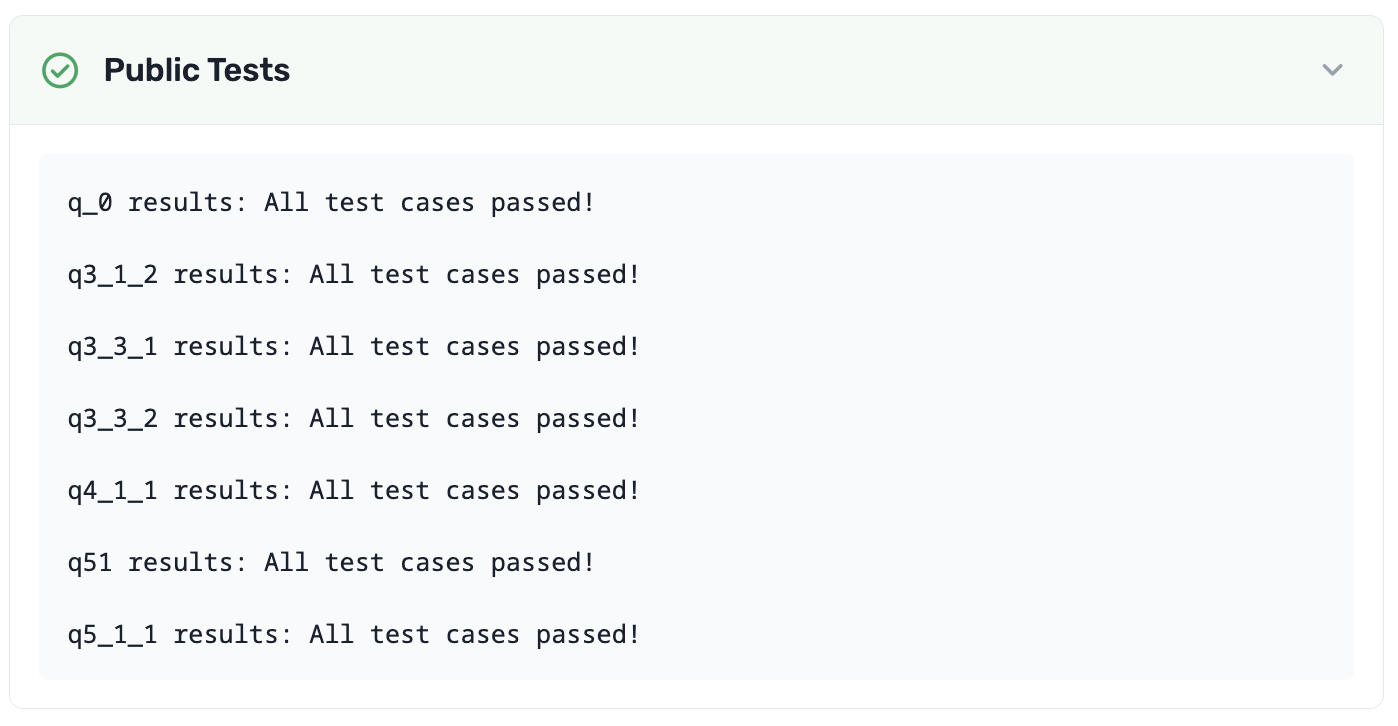
Once you have submitted to the autograder, your Pensieve assignment should look something like the following image if you have passed all public tests.
Note: This is a photo of a generic Pensieve submission result, and it does not included the same test numbers as this assignment. Please check that all test cases have passed for each question.
To double-check your work, the cell below will rerun all of the autograder tests.
grader.check_all()Submission
Make sure you have run all cells in your notebook in order before running the cell below, so that all images/graphs appear in the output. The cell below will generate a zip file for you to submit. Please save before exporting!
# Save your notebook first, then run this cell to export your submission.
grader.export(pdf=False)